
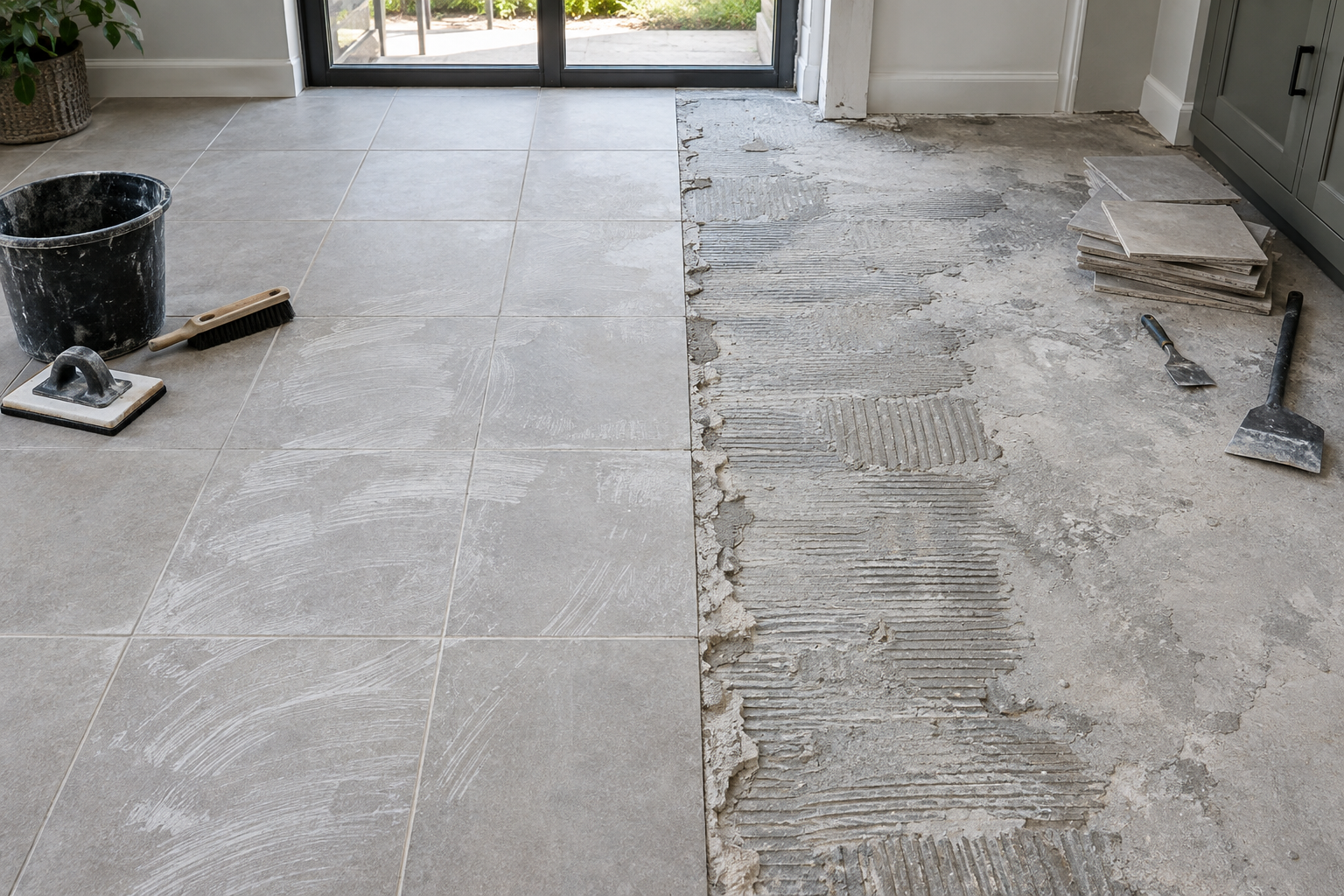
When replacing old flooring, homeowners often face two options: remove the existing tiles or install new tiles directly over them.
Both methods can produce a completely new appearance, but the preparation, renovation process and suitability of each method are different.
If you are deciding between tile overlay and hacking in Singapore, understanding these differences can help you discuss the right solution with your tiling contractor.
What Is Tile Overlay?
Tile overlay means installing new tiles over an existing tiled surface rather than removing the original tiles first.
The existing floor or wall becomes the base for the new installation.
Before overlaying, the contractor should inspect the existing tiles and surface condition. The area needs to be sufficiently stable for the new tiles to be installed properly.
Overlay is commonly considered when homeowners want to update the appearance of an existing tiled space while reducing the amount of removal work involved.
What Is Tile Hacking?
Hacking involves removing the existing tiles before installing the new finish.
After the old tiles are removed, the underlying surface can be inspected and prepared.
Depending on its condition, additional work such as repair, waterproofing or cement screeding may be needed before new tiles are installed.
Hacking provides access to the original substrate, which can be useful when the existing flooring has significant problems.
Tile Overlay vs Hacking
The main difference is what happens to the existing tiles.
With overlay: existing tiles remain in place and the new tiles are installed above them.
With hacking: existing tiles are removed and the new installation begins from the underlying surface.
The better method depends on the condition of the property rather than simply choosing the faster option.
Advantages of Tile Overlay
Less Removal Work
Because the existing tiles remain in place, there is less hacking and removal work. This can reduce the amount of debris generated during renovation.
Shorter Renovation Process in Suitable Areas
Removing an existing tiled floor takes additional time. When the existing surface is suitable for overlay, the installation process may involve fewer stages.
Useful for Updating an Existing Design
Older tiles can make an otherwise well-maintained home look dated. Overlay allows homeowners to change the colour, size or design of the tiled surface without necessarily removing the entire existing finish.
Less Disruption
Hacking can be noisy and involves considerably more debris. For homeowners carrying out a limited renovation, overlay may provide a less disruptive solution when site conditions allow it.
When Tile Overlay May Not Be Suitable
Overlay is not automatically suitable for every tiled floor. Several conditions need to be checked first.
Existing Tiles Are Loose or Hollow
The new tiles depend on the stability of the surface below them. If many existing tiles are already loose, moving or hollow, installing another layer over them may not address the underlying issue.
Existing Surface Is Uneven
Large height differences or uneven flooring may affect the finished result. The surface may require repair or levelling before any new installation is considered.
Floor Height Is Already Limited
Overlay adds another layer to the existing floor. This can affect areas such as:
- Door clearance
- Entrance transitions
- Built-in carpentry
- Floor traps
- Bathroom thresholds
- Connections between rooms
These details should be checked before proceeding.
Existing Tiles Are Seriously Damaged
If the current tiled surface has widespread cracking or movement, removing it may allow the contractor to investigate the cause more effectively.
Advantages of Hacking Existing Tiles
Access to the Underlying Surface
One of the biggest advantages of hacking is that the original surface becomes visible. The contractor can identify damaged or uneven areas before installing the new floor.
Suitable for Major Renovations
If you are already carrying out extensive renovation work, removing the old floor may fit naturally into the overall project.
Allows More Complete Surface Preparation
Once the existing tiles have been removed, the contractor can carry out any required screeding, levelling or repair work. For wet areas, this also provides an opportunity to assess the condition of the surface before proceeding with the next stage of renovation.
Disadvantages of Hacking
Hacking involves additional work compared with a straightforward overlay installation. This may include:
- Breaking the existing tiles
- Removing debris
- Disposal
- Surface cleaning
- Repair work
- Screeding
- Additional preparation before tiling
It can also create more noise and dust during renovation.
Is Overlay Suitable for Bathrooms?
Bathroom tile overlay needs to be assessed carefully. Bathrooms involve more than appearance.
The contractor also needs to consider:
- Drainage
- Floor slopes
- Floor traps
- Door thresholds
- Existing tile condition
- Waterproofing
- Wall and floor transitions
Adding another tile layer changes the finished floor height, which may affect these areas. For this reason, bathroom overlay should not be decided based only on whether the existing tiles look visually acceptable. The full site condition should be checked first.
Is Overlay Suitable for Kitchen Floors?
Kitchen tile overlay may be possible when the existing floor remains stable and the additional height does not interfere with cabinets, doors or adjacent flooring.
Existing built-in kitchen carpentry can make floor-height planning especially important. A contractor should assess these details before work begins.
What About Living Rooms and Bedrooms?
Larger dry areas such as living rooms may be relatively straightforward to assess.
However, the contractor should still check for:
- Hollow tiles
- Cracked areas
- Uneven flooring
- Floor transitions
- Main entrance clearance
- Bedroom door clearance
The existing tiled surface needs to provide a reliable base for the new installation.
Does Overlay Save Money?
Tile overlay can involve less removal work, which may reduce some labour and disposal requirements.
However, the final project cost still depends on:
- Floor condition
- Area size
- Tile type
- Tile size
- Levelling requirements
- Layout
- Cutting
- Additional renovation work
It is therefore better to compare the complete scope of work rather than assume that one method will always be cheaper.
How to Decide Between Overlay and Hacking
Before choosing, ask your tiling contractor to inspect the existing flooring.
Some useful questions include:
- Are the existing tiles secure?
- Are there hollow areas?
- Is the floor sufficiently level?
- Will the new floor height affect the doors?
- What happens at the entrance?
- Will drainage be affected?
- Is additional screeding required?
- Are there signs of underlying damage?
These questions help determine whether the existing tiled surface is suitable to remain in place.
Choose Based on the Existing Condition
There is no single answer to whether overlay or hacking is better.
A stable existing tiled floor may be suitable for overlay, while a floor with widespread damage, movement or other underlying issues may require removal and preparation before new tiles are installed.
The important step is to assess the existing condition before deciding.
Top Construction provides tile overlay, wall and floor tile installation, tile replacement, screeding, waterproofing and related renovation works for properties in Singapore.
If you are unsure whether your existing floor can be overlaid, arrange for the area to be inspected before choosing your renovation method.
Tile Overlay FAQs for Singapore Homes
Can you overlay tiles in a Singapore home?
Homeowners comparing overlay tiles Singapore options should first confirm that the existing tiled surface is stable, level and firmly bonded. Overlay tiles can refresh a floor or wall with less hacking, but the new finish still depends on the condition underneath. Loose, hollow, cracked or moving tiles may need to be removed before a reliable installation can begin.
Is it safe to overlay bathroom tiles?
A contractor may overlay bathroom tiles only after checking drainage, floor falls, door clearance, floor traps, waterproofing considerations and the condition of the original tiles. Bathroom tiling involves wet-area details that do not apply in a dry room. If the existing surface is unstable or the extra height affects drainage, hacking and rebuilding the base may be the safer approach.
How does a toilet floor tiles overlay affect drainage?
A toilet floor tiles overlay adds height to the finished floor. This can change the relationship between the tiles, floor trap, doorway and surrounding rooms. The contractor must preserve the correct slope toward the drain and avoid creating low points where water can collect. The proposal should explain how levels and thresholds will be managed before installation starts.
What should homeowners check before a toilet tiles overlay?
Before approving a toilet tiles overlay, check for hollow tiles, cracks, movement, leaking joints, damaged grout and uneven areas. Ask how the contractor will prepare the surface and treat fixtures, pipe penetrations and wall-floor junctions. When discussing plans to overlay toilet tiles Singapore homeowners should also confirm whether existing waterproofing or drainage concerns require a more extensive renovation method.
Can contractors overlay floor tiles throughout the home?
Contractors can overlay floor tiles in suitable living rooms, bedrooms, kitchens and other areas, but each transition must be assessed. Check the main entrance, bedroom doors, built-in carpentry, kitchen cabinets and connections to bathrooms or balconies. A level and stable base is essential, and the added height should not stop doors from opening or create awkward steps between rooms.
When is hacking better than tile overlay?
Hacking is usually the better choice when many tiles are loose or hollow, the floor is badly uneven, cracks suggest movement, or the substrate needs repair. It also gives the contractor access for screeding and surface preparation. Overlay is most useful when the existing installation remains sound and the added floor height will not cause functional problems.
Unsure whether overlay is suitable?
Arrange a site assessment so we can inspect the existing tiles, floor levels and drainage.